£0.00


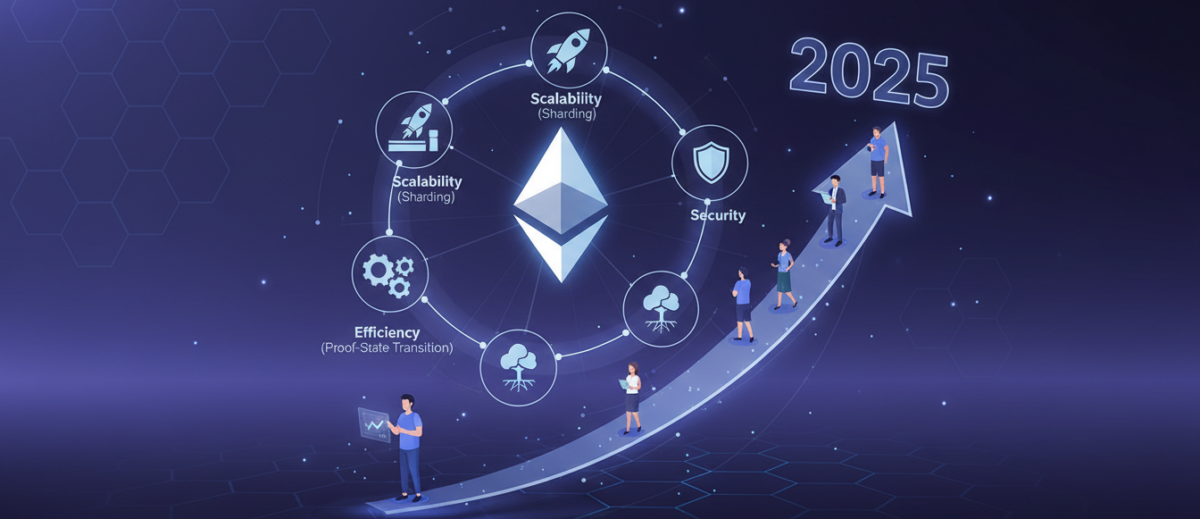
The Ethereum roadmap 2025 marks one of the most ambitious upgrades in the network’s history. With detailed updates from Vitalik Buterin and the core research team, the community now has a clearer view of how Pectra, Danksharding, rollup-centric scaling, Verkle trees, and account abstraction will transform the ecosystem. Although the terminology can appear intimidating, the practical consequences are straightforward: lower fees, smoother developer workflows, more efficient DeFi, and a vastly improved experience for everyday users. This article breaks down the roadmap without technical jargon, translating the upgrades into concrete impacts.
Understanding the New Ethereum Roadmap for 2025
Ethereum is shifting from a monolithic chain into a modular ecosystem built around rollups and data availability solutions. The 2025 roadmap integrates several components into a coherent vision. Pectra, the merger of the Prague and Electra upgrades, prepares the protocol for future transformations. Danksharding redefines how Ethereum handles data, enabling a massive increase in rollup capacity. Verkle trees streamline state storage, making nodes more efficient. Meanwhile, account abstraction allows smoother, more flexible interactions for users and developers.
Each of these upgrades targets a specific pain point: fees that fluctuate wildly, slow confirmation times, complex wallet interactions, and infrastructure that strains under growing demand. The roadmap aims to eliminate these issues step by step.
What Pectra Actually Changes
Pectra delivers several foundational improvements. While much of the work happens behind the scenes, the net effect becomes visible in everyday interactions.
Pectra includes early steps toward Verkle trees, replacing the current Merkle Patricia structure with a more compact and scalable one. This shift reduces node requirements and improves synchronization. As a result, Ethereum becomes more accessible for smaller operators and contributes to decentralization.
Pectra also introduces upgrades that support future rollup growth. This is crucial because rollups serve as Ethereum’s scaling engine. When rollups operate more efficiently, fees across the entire ecosystem fall. Therefore, Pectra acts as a preparatory stage for the major changes coming with Danksharding.
Danksharding: The Real Unlock for Scaling
Danksharding is the centerpiece of the Ethereum roadmap 2025. Rather than splitting the chain into multiple shards with independent states, Ethereum focuses on data availability sampling and specialized “blob” space designed for rollups. Danksharding increases the amount of data Ethereum can include in blocks, enabling rollups to post more data at lower cost.
For users, this translates to dramatically cheaper transactions. Rollup fees drop because the cost of posting data to Ethereum’s base layer shrinks. DeFi becomes more affordable, NFT trading becomes less expensive, and everyday wallet interactions no longer feel prohibitive.
The shift also helps developers. Rollup teams gain more predictable costs and can design products without worrying about sudden congestion spikes. This stability could encourage new projects and improve the reliability of existing ones.
Verkle Trees: A Silent but Crucial Upgrade
Although Verkle trees rarely appear in headlines, they may be one of the most impactful upgrades. They allow Ethereum to validate state with much smaller proofs. This improvement reduces the computational and storage load for nodes.
With Verkle trees, running a node becomes easier and lighter. This promotes a healthier network because more people can participate directly rather than relying on centralized providers. A network with more nodes is more resilient, more censorship-resistant, and less dependent on large infrastructure operators.
For the average user, this upgrade works in the background. However, it increases overall network health and indirectly supports cheaper fees by creating a more efficient base layer.
Account Abstraction: A New Era for UX
Account abstraction changes how wallets function. Instead of relying on rigid externally owned accounts (EOAs) and seed phrases, users gain smart contract wallets with flexible rules. This enables features such as:
-
Social recovery instead of seed phrase management
-
Automatic gas payments using tokens other than ETH
-
Bundled transactions for smoother app interactions
-
Multisig-style security without complicated setups
For the average user, Ethereum becomes more intuitive. The era of losing funds due to forgotten seed phrases or navigating confusing transaction prompts begins to fade. Developers also gain a new toolbox to design products that behave like modern applications rather than legacy financial tools.
What These Changes Mean for Fees
All major roadmap items contribute to lower and more stable fees. Danksharding and Pectra expand rollup capacity. Verkle trees optimize node performance. Account abstraction reduces overhead for wallet operations.
By 2025, Ethereum evolves further into a settlement and data layer. Most user activity moves to rollups, where transactions cost far less. This creates a more predictable cost environment for developers and users.
The shift does not eliminate congestion entirely, but it reduces extreme spikes. As a result, everyday tasks—sending tokens, trading small amounts, minting NFTs—become far more accessible.
Impact on DeFi: Stability, Efficiency, and New Design Space
DeFi stands to gain significantly from roadmap upgrades. Lower rollup fees reduce slippage, improve liquidity routing, and make complex transactions more affordable. For derivatives platforms and lending protocols, predictable base-layer costs simplify risk management.
Upgrades to cryptographic structures—such as Verkle trees—also increase the scalability of protocols that require heavy data interaction. Developers can build richer applications without worrying about hitting performance limits.
The enhanced UX introduced by account abstraction could trigger a new adoption wave. Users trade and manage portfolios with far fewer steps, removing friction that historically discouraged participation.
What Changes for Developers
Developers gain a more stable environment with clearer guarantees. The roadmap reduces uncertainty around data availability and fees, enabling long-term planning. Building on rollups becomes the standard path, supported by a strong ecosystem of tools and documentation.
Account abstraction unlocks creativity. Developers can design custom transaction flows, embedded security models, and multi-step interactions that appear seamless to users. This opens an entirely new layer of application design.
Moreover, reduced node requirements lower the barrier to running infrastructure. Small teams gain the ability to operate nodes without heavy hardware investments, improving decentralization across the development landscape.
What Changes for the Average User
The roadmap transforms Ethereum from a powerful but intimidating network into a platform fit for mainstream adoption. Users benefit from:
-
Much lower fees on rollups
-
Simpler wallet management through account abstraction
-
Faster confirmation times
-
More intuitive app experiences
-
More stable DeFi interactions
Ethereum becomes easier to use, cheaper to navigate, and more consistent. The network shifts from a technical playground into a polished digital economy.
Conclusion
The Ethereum roadmap 2025 is not merely a list of upgrades. It represents a structural transformation of Ethereum’s architecture and user experience. Pectra prepares the protocol’s foundations, Danksharding scales the ecosystem through specialized data, Verkle trees optimize state storage, and account abstraction reshapes interaction models. Together, these upgrades reduce fees, strengthen DeFi, simplify development, and elevate the user experience. As Ethereum enters 2025, the network moves closer to delivering a scalable, accessible, and resilient foundation for the next generation of decentralized applications.