£0.00



Introduction: why “Ethereum Pectra” matters now
The Ethereum Pectra upgrade blends execution-layer and consensus-layer improvements into a single step forward. It focuses on safer keys, smoother wallet flows, and more scalable data for apps. For everyday users, that translates into fewer scary signatures and clearer cost controls. For developers, it unlocks cleaner patterns for account logic, data availability, and long-term UX upgrades that make Ethereum feel less like a developer tool and more like consumer-grade finance.
What changed under the hood: accounts, keys, and programmability
Ethereum’s base model long separated externally owned accounts (EOAs) from smart contract accounts. Pectra narrows that gap. In practice, it becomes easier to attach policy logic to your account without migrating funds or teaching users new seed phrases. As a result, apps can enforce spending limits, time locks, or session rules at the account level. Crucially, this logic can be updated safely, so wallets no longer feel “frozen in time” the day you create them.
Beyond policy logic, Pectra formalizes clearer interfaces for wallets to coordinate with dapps. Instead of brittle, app-specific workarounds, wallets can expose capabilities—like rate limits or allowed spenders—that dapps can query and respect. The result is a consistent contract between wallets and apps, which reduces foot-guns and odd edge cases.
Better wallet UX: fewer signatures, more safety rails
Wallets are the face of Ethereum, and Pectra improves that face in three ways:
-
Session-style approvals: Users can authorize a dapp to perform a set of actions for a limited time or within preset limits. You no longer confirm twenty small steps; you approve a well-scoped session and keep full revocation power.
-
Native spending rules: Think of them as guardrails. You can cap daily outflows, restrict specific token contracts, or require an extra confirmation above a threshold.
-
Clearer human-readable prompts: Transactions surface what will really change—balances, approvals, and target contracts—so you can tell upgrades from exploits at a glance.
Together, these changes reduce signature fatigue. They also cut accidental infinite approvals, a common cause of losses for DeFi newcomers.
Why this is a big deal for DeFi
DeFi lives on composability, but composability is only safe if the account model is resilient. Pectra helps by:
-
Making approvals safer by default. Session rules and spending limits blunt the risk of malicious routers and “approval forever” UX traps.
-
Smoothing multi-step flows. Complex interactions—like leverage loops or multi-venue swaps—bundle into a single, auditable session rather than a dozen fragile clicks.
-
Improving oracle and keeper reliability. Cleaner account logic makes automated agents easier to permission and monitor, lowering operational risk for vaults, perps, and money markets.
As trust improves, more users are willing to try on-chain lending, trading, and structured products without feeling like they need a security PhD.
Real-world assets (RWA): from pilots to pipelines
Tokenized treasuries, invoices, and funds need more than a chain; they need account-level rules and predictable operations. Ethereum Pectra helps RWA platforms by:
-
Embedding compliance policies at the account layer. Whitelists, velocity limits, and time-bound permissions can live with the investor account, not in ad-hoc middleware.
-
Supporting institutional custody models. Multi-operator controls (for example, ops + compliance) reduce single-key risk while keeping workflows fast enough for daily NAV and settlements.
-
Enhancing data throughput for rollups. With improved data-availability pathways, L2s can batch more transactions at lower cost, which suits RWA transfer volumes and corporate actions.
These features make tokenization less about shiny demos and more about dependable back-office plumbing.
Developer experience: cleaner patterns, fewer edge cases
For builders, Pectra is a quality-of-life release:
-
Unified account interfaces. You can design for one consistent set of hooks to verify, execute, and recover user intent. That slashes boilerplate and reduces fragmentation across wallets.
-
Safer upgrade paths. Account logic can evolve under transparent constraints, so you can fix bugs or add features without forcing users to migrate assets or rotate keys.
-
Gas and calldata ergonomics. Encodings are more predictable, signatures are easier to validate, and batching paths are clearer—useful for aggregators and intent solvers.
The bottom line: fewer bespoke patches, more reusable libraries, and simpler audits.
Security posture: what improves and what still needs care
Pectra does not magically remove risk, but it changes the risk curve:
-
Key risk shifts to policy risk. Users depend less on a single seed phrase and more on the rules protecting their funds. That is good, yet bad policies can still lose money.
-
Approval risk decreases. Session limits and human-readable prompts make toxic approvals rarer.
-
Smart-contract risk remains. Upgrades, delegates, and external calls still need thorough reviews, formal verification where possible, and strong monitoring.
Therefore, threat modeling must cover the policy layer (limits, whitelists, revoke paths) as carefully as the core contract logic.
Ecosystem impacts: wallets, L2s, and tooling
Wallet teams gain a clearer roadmap: converge on session permissions, standard prompts, and recovery flows. Rollups benefit because better data-availability handling and cleaner account semantics reduce L2 differences that leak into app code. Tooling vendors—indexers, security scanners, and analytics—can flag risky sessions or policy changes in near-real time, not weeks later.
For users, this convergence feels like a single network with consistent rules. For developers, it means an app written against the Pectra patterns should “just work” across major L2s with minimal tweaks.
Governance and operations: upgrade safety and recovery
Pectra nudges the ecosystem toward recoverable accounts. Social or hardware-based recovery can be built into the account itself with transparent safeguards, such as time-delayed changes and public event logs. Teams can rotate operators without downtime, and users can recover from device loss without exposing seed phrases to risky environments.
Moreover, standardized prompts make governance safer. When a DAO submits a proposal that changes a vault’s withdrawal rules, the signer sees exactly which permission is changing before confirming.
Why this matters for mainstream adoption
People adopt systems that are easy, safe, and cheap. Ethereum Pectra moves the chain toward all three. Wallets feel safer and less noisy. DeFi feels less intimidating. RWAs gain the controls institutions need. And L2s get the scaling headroom to run these experiences at consumer price points. It is the most “user-facing” core upgrade in years—even though much of the work hides under the surface.
Mini-guide: what to check before you sign any transaction
Use this checklist every time, even with Pectra’s guardrails:
-
Who am I really talking to? Confirm the dapp URL, connected chain, and wallet name. Fake pop-ups remain common.
-
What will change? Read the human-readable summary. Look for balance deltas, token IDs, and any new approvals.
-
Is this a session or a one-off? For sessions, check time limits, spending caps, and which contracts are allowed. Avoid “unbounded” scopes.
-
Which tokens and which contract addresses? Verify the exact contract you’re approving or calling, not just its symbol.
-
Are there hidden approvals? Many swaps include permit/approve calls. If you only intended to trade, consider lower allowances or single-use permits.
-
What are the safeguards? Ensure your account policy has daily limits, whitelists, or a second-factor for large transfers.
-
Can I revoke easily? Know where to revoke approvals and how to end a session. Keep that page bookmarked in your wallet.
-
How will I recover if something breaks? Confirm your recovery method (guardians, hardware, or timelock) and test a dry run with small funds.
-
What’s the gas and total cost? Check the maximum you could pay under current conditions. If it looks off, wait or switch networks.
-
Am I rushing? Scams thrive on urgency. If a timer is pressuring you, step back.
Conclusion: a safer, cleaner, more capable Ethereum
The Ethereum Pectra upgrade tightens the link between security and usability. It standardizes account-level protections, reduces signature fatigue, and gives builders clean, scalable primitives. DeFi becomes more trustworthy, while real-world assets gain the operational controls institutions demand. Most importantly, users get a network that feels modern without sacrificing self-custody. Keep your policies tight, your sessions scoped, and your eyes on the prompt—Pectra has done its part; now it’s our turn to use it well.

Introduction: A new rulebook for dollar-pegged money
The GENIUS Act stablecoin framework is now the cornerstone of U.S. policy for payment-token issuers. Enacted in July 2025 with broad bipartisan support, it delivers long-sought clarity on who may issue payment stablecoins, how reserves must be held and audited, and what compliance programs are mandatory. That clarity is already catalyzing moves by banks, fintechs, and global payment networks eager to plug stablecoins into everyday commerce.
What the GENIUS Act actually covers
At its core, the Guiding and Establishing National Innovation for U.S. Stablecoins (GENIUS) Act creates a federal regime for payment stablecoins—tokens redeemable at par in fiat and used for payments. It sets out who can issue, how they are supervised, and how foreign-issued tokens may be offered or traded in the U.S. The Act takes effect on the earlier of 18 months from enactment or 120 days after primary regulators finalize rules—so compliance programs must be underway now.
Why Congress acted now
Stablecoins have swelled into a multi-hundred-billion-dollar market and an increasingly important back-end rail for crypto and, increasingly, mainstream payments. Lawmakers responded to both systemic-risk concerns and a strategic view that well-regulated dollar tokens can reinforce U.S. monetary primacy in digital markets.
Issuer obligations: AML, audits, and classifications
Mixture-of-rules regimes are over: the GENIUS Act makes issuer status, controls, and disclosures explicit.
AML/KYC programs as for financial institutions
Issuers are treated as financial institutions for Bank Secrecy Act purposes. They must maintain risk-based AML/CFT programs, designate compliance officers, conduct customer due diligence (CDD/KYC), file SARs where applicable, and maintain robust sanctions screening. This ends the ambiguity that previously let some issuers rely on partners to “own” AML.
Independent audits and reserve attestations
The law requires independent third-party assurance over reserves and financial statements on a recurring basis, with standardized disclosures so users can assess liquidity, asset mix (e.g., cash, T-bills), and concentration risk. Expect quarterly reserve attestations and annual audits to become standard issuer hygiene.
Permissible assets and prudential safeguards
Issuers must hold high-quality liquid assets—typically cash and short-dated U.S. Treasury bills—segregated for the benefit of token holders. Detailed governance, risk, and custody controls apply, including wind-down and insolvency playbooks that clarify treatment of reserves if an issuer fails.
Federal–state perimeter and “who can issue”
The GENIUS Act builds a federal licensing and supervision layer while accommodating certain state frameworks and providing tools for the Fed or OCC to intervene in unusual circumstances (notably for state-chartered issuers). Foreign issuers face tailored rules for offering and secondary trading in the U.S. through digital asset service providers.
What it means for banks
A new product line—within familiar compliance rails
For insured depository institutions, stablecoins become a regulated, auditable deposit-adjacent product. Banks can now issue or distribute tokens with better clarity on capital, liquidity, and supervisory expectations. This opens use cases from on-chain commercial payments to instant wholesale settlement between corporate treasuries.
Balance-sheet opportunities—and responsibilities
With reserves largely in cash and T-bills, banks can participate as custodians, trustees, or liquidity agents. The flip side: ALM, concentration, and operational risks (smart-contract security, key management) move under bank-grade controls and examiner scrutiny. Insolvency and segregation provisions heighten fiduciary duties toward token holders.
What it means for fintech and crypto-native issuers
License pathways and higher compliance costs
Non-bank issuers must meet bank-like standards: rigorous AML, governance, cybersecurity, and audit cadence. Many will seek partnerships with banks for custody, cash management, and compliance “co-sourcing,” while building internal capabilities to pass ongoing supervisory exams. Strong actors gain; marginal players face consolidation.
Distribution through regulated intermediaries
Exchanges and wallets operating in the U.S. will need policies for listing, secondary trading, and surveillance tailored to GENIUS Act classifications—especially for foreign-issued stablecoins now subject to explicit U.S. access rules and potential exemptions or waivers.
Why the payments giants are moving now
Regulatory certainty reduces integration risk
Card networks and global PSPs have eyed stablecoins for years to accelerate cross-border payments, reduce nostro balances, and enable programmable settlement. Post-GENIUS, the legal risk discount shrinks, clearing the way for pilots and phased rollouts across merchant acquiring and B2B payouts.
The network-effects moment
With a federal floor in place, merchants and platforms can negotiate SLAs around redemption windows, cut-off times, and chargeback analogs. As rails standardize, stablecoins shift from crypto niche to embedded financial infrastructure, encouraging big-tech wallets and PSPs to add stablecoin rails alongside cards and ACH.
GENIUS vs. MiCA: convergences and friction points
The EU’s MiCA already governs e-money tokens and asset-referenced tokens, with sell-only and delisting levers when issuers fall short. GENIUS now provides the U.S. counterpart: both regimes demand licensing, reserve quality, and disclosures—yet they differ in institutional perimeter and passportability. Multinationals must design compliance architectures that map controls to both jurisdictions without duplicating effort.
Operational checklist: getting to day-one compliance
1) Governance & classification
Define whether your token is in-scope as a payment stablecoin; stand up a board-level risk committee; document redeemability terms and wind-down triggers aligned to GENIUS.
2) Reserves & custody
Adopt a permissible-assets policy (cash/T-bills), segregation mechanics, tri-party agreements, and daily liquidity monitoring. Prepare for quarterly attestations and annual audits.
3) AML/CFT & sanctions
Build BSA-compliant programs (CDD, ongoing monitoring, SAR, sanctions), with risk scoring for counterparties and chain-analytics integrations.
4) Technology & security
Institute change-management for smart contracts, multi-sig/HSM key custody, incident response, and continuous monitoring; align with examiner-ready cybersecurity frameworks.
5) Market access & disclosures
Draft standardized reserve reports, publish transparency dashboards, and align exchange listing packets to U.S. and EU templates to streamline approvals.
Strategic implications for the next 12–24 months
-
Balance-sheet yield meets instant settlement: With T-bill-backed reserves, issuers can fund operations via interest income while offering instant retail and B2B settlement—if they maintain liquidity buffers for stress redemptions.
-
Consolidation wave: Compliance cost curves favor scale; expect M&A and bank-fintech partnerships.
-
Dollar dominance in digital form: Clear U.S. rules amplify dollar-stablecoin adoption globally, reinforcing the greenback’s role in crypto and cross-border commerce.
Conclusion: Clarity unlocks adoption
The GENIUS Act stablecoin regime ends the wait-and-see era. By hard-coding AML duties, audit obligations, permissible reserves, and a licensing perimeter, it gives banks and fintechs the confidence to build for real-world payments. For issuers, the bar is higher—but so is the prize: access to mainstream commerce with regulatory legitimacy on both sides of the Atlantic. The winners will be those who operationalize compliance as a product feature—transparent reserves, reliable redemption, and programmable money that actually works at checkout.

Introduction: Understanding the Stablecoin Peg
A stablecoin peg is the mechanism that ensures the value of a stablecoin stays tied to a reference asset, usually the U.S. dollar or the euro. Without a reliable peg, stablecoins lose their main purpose: providing stability in the volatile crypto market.
But how do stablecoins actually maintain their peg? The answer lies in collateral models, reserve assets, and regulatory oversight. With the EU’s MiCA framework entering into force, the rules for stablecoins in Europe are evolving rapidly.
How Stablecoins Maintain Their Peg
On-Chain Collateral Models
Some stablecoins, like DAI, rely on on-chain collateral. This means users lock up digital assets such as Ether (ETH) or USDC into smart contracts. The system then issues stablecoins against this collateral at overcollateralized ratios (e.g., $150 of ETH for $100 of DAI).
If the collateral value falls below thresholds, the smart contract liquidates it automatically. This mechanism provides transparency and decentralization, since reserves are visible on-chain and governed by code.
Off-Chain Collateral Models
Other stablecoins, like USDC or Tether’s USDT, are backed by off-chain collateral. Their issuers hold real-world reserves such as cash, commercial paper, or more recently, U.S. Treasury bills (T-bills).
Holders can redeem their stablecoins for fiat, which keeps the price anchored. However, transparency depends on audits and disclosures rather than blockchain data, raising concerns about trust and opacity.
The Role of Treasury Bills and Reserves
T-bills have become a key instrument in maintaining a stablecoin peg. Issuers invest reserves into short-term government bonds, which provide both safety and yield. This allows them to cover redemption requests while earning income.
For example, Tether and Circle hold billions in T-bills, effectively making them significant players in U.S. debt markets. While this provides liquidity, it also ties stablecoins to traditional financial risks, such as interest rate shifts or government shutdowns.
Risks of De-Pegging
Market Shocks
During times of stress, stablecoins can lose their peg. For instance, USDC briefly de-pegged in March 2023 when its reserves at Silicon Valley Bank became temporarily inaccessible. Market panic drove its price below $0.90 before recovering.
Algorithmic Failures
Algorithmic stablecoins, such as TerraUSD (UST), failed spectacularly in 2022. Their peg relied on incentives and token dynamics rather than robust collateral. Once market confidence collapsed, the system spiraled into a death loop.
Liquidity Crunches
Even collateralized stablecoins face risks if too many users redeem at once. If issuers cannot liquidate assets quickly enough, the peg may wobble. This is especially dangerous for those relying on less liquid assets as reserves.
MiCA and the Future of Stablecoin Pegs in the EU
Stricter Authorization Requirements
Under MiCA, stablecoin issuers must be authorized and meet strict conditions. This includes holding sufficient reserves, publishing detailed disclosures, and being subject to ongoing supervision.
This reduces the risk of opaque collateral structures, ensuring that only well-capitalized, transparent issuers can operate in the EU.
Sell-Only and Delisting Rules
If a stablecoin fails to meet MiCA requirements, European crypto exchanges may be forced into sell-only mode. Users would be allowed to redeem existing tokens but not acquire new ones. Over time, this could lead to delisting.
This creates strong incentives for issuers to comply, since losing access to the EU market would reduce adoption significantly.
Protecting Users and Markets
For consumers, MiCA ensures better protection. Issuers must prove that reserves are safe, accessible, and properly audited. For the broader market, this means fewer risks of sudden de-pegs caused by mismanagement or hidden vulnerabilities.
Conclusion: Stability Meets Regulation
The stability of a stablecoin peg depends on collateral transparency, reserve quality, and robust mechanisms to handle market shocks. On-chain models offer openness but can be volatile, while off-chain models rely on trust in issuers and traditional assets like T-bills.
With MiCA, Europe is introducing one of the world’s most comprehensive stablecoin regimes. By enforcing authorization, disclosure, and user protection rules, the EU aims to ensure that stablecoins truly live up to their name — stable.
For users and firms alike, the message is clear: the era of unregulated stablecoins is ending, and the future will be shaped by compliance and accountability.
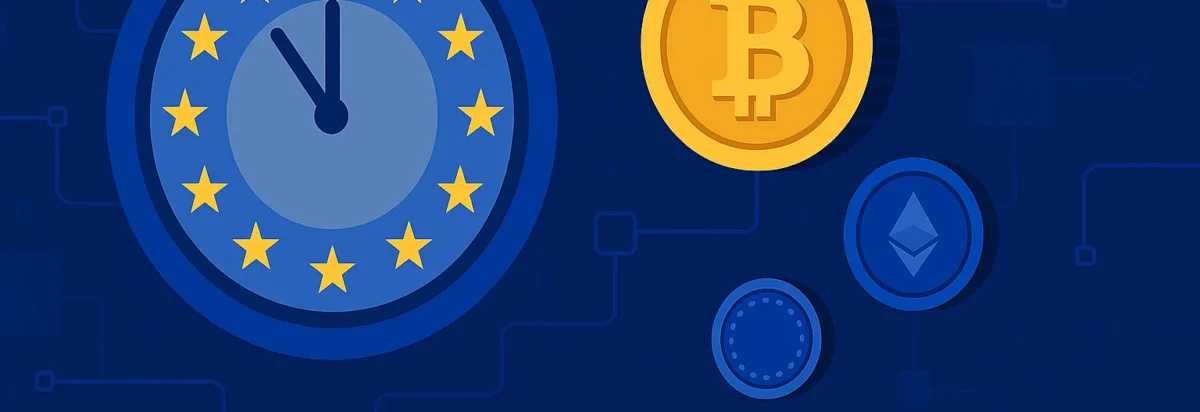
Introduction: The MiCA Countdown Begins
The European Union’s MiCA regulation (Markets in Crypto-Assets) is about to reshape the future of digital assets in Europe. After years of debate, the rules are now entering into force with concrete deadlines that crypto-asset service providers (CASPs) can no longer ignore.
While the regulation offers much-needed clarity, it also comes with a strict timeline. Some firms will benefit from grandfathering periods, while others must act quickly to comply with new licensing requirements and technical standards. For users, this means more transparency, safer markets, and significant changes in token availability across EU platforms.
MiCA’s Timeline: Deadlines and Grandfathering Periods
Official Enforcement Dates
MiCA was adopted in 2023, with phased implementation set between 2024 and 2026. Key dates include:
-
June 2024: Stablecoin rules (asset-referenced tokens and e-money tokens) took effect.
-
December 2024: CASPs must start applying for licenses, with requirements enforced across all EU member states.
-
Mid-2025 onward: Transition periods expire, meaning unlicensed providers will no longer be allowed to operate.
Grandfathering Rules for CASPs
Not all providers face an immediate cut-off. MiCA allows for grandfathering clauses, meaning existing crypto businesses can continue operating temporarily under national rules while applying for an EU license.
-
Up to 12–18 months: Depending on the member state, firms may continue serving clients if they were authorized under local law before MiCA.
-
After the grace period: Only fully MiCA-compliant entities will be allowed to operate across the EU single market.
This ensures a smoother transition but also puts pressure on firms to prepare compliance roadmaps quickly.
Key Technical Standards Under MiCA
Whitepapers and Disclosure Requirements
Issuers of crypto-assets must publish whitepapers that follow MiCA’s strict templates. These documents must clearly outline risks, rights, and obligations — eliminating vague or misleading descriptions that plagued earlier ICO markets.
Prudential Safeguards
CASPs must hold minimum capital requirements, ensuring financial stability. Custodians must implement enhanced segregation of client assets and robust cybersecurity protocols.
Supervision and Reporting
MiCA empowers national regulators and the European Securities and Markets Authority (ESMA) to enforce reporting standards. CASPs must provide regular updates on operations, liquidity, and consumer protection mechanisms.
These technical rules aim to align crypto firms with the same level of trust as traditional financial institutions.
Impact on Token Listings and Delistings
Stricter Criteria for Token Listings
Under MiCA, CASPs will be required to adopt formal listing policies. Tokens must meet transparency and compliance checks before they can be offered to EU customers. This means many speculative or lightly documented tokens may not qualify.
Increased Delisting Activity
The flipside is clear: CASPs will also face pressure to delist tokens that fail to meet MiCA’s disclosure or prudential standards. Platforms may need to streamline offerings, focusing on assets with regulatory approval.
User Communication Obligations
MiCA also introduces strong obligations for user communication. CASPs must:
-
Notify customers in advance of any delisting.
-
Provide clear explanations for risks and regulatory decisions.
-
Offer accessible complaint and redress mechanisms.
This is designed to prevent the kind of sudden withdrawals or opaque decisions that have damaged trust in the sector.
What MiCA Means for Crypto Firms
Compliance as a Competitive Advantage
Firms that move quickly to align with MiCA will gain first-mover advantages, particularly in winning institutional and corporate clients who demand regulatory clarity.
Costs and Operational Burdens
Smaller CASPs may struggle with the compliance costs, including legal, reporting, and IT infrastructure upgrades. Some may exit the market or consolidate with larger players.
The Single EU Market Opportunity
Once licensed, CASPs can operate across all EU states without reapplying locally. This passporting system mirrors existing rules in traditional finance and could make Europe one of the most attractive crypto markets worldwide.
MiCA and the User Experience in Europe
For European users, MiCA brings several tangible benefits:
-
Safer markets: Reduced exposure to scams and poorly backed assets.
-
Better transparency: Clearer information about tokens and service providers.
-
More trust in exchanges: Regulated custodians and platforms reduce counterparty risk.
However, users may also face a shrinking range of token options as platforms adjust to regulatory pressure.
Conclusion: The Final Countdown for Compliance
The MiCA regulation is not just another piece of EU legislation; it is a watershed moment for the crypto industry. With deadlines approaching, CASPs must act fast to secure licenses, align with technical standards, and restructure their token offerings.
For regulators, this is about ensuring Europe leads in shaping safe and transparent digital finance. For users, it marks a transition toward a more secure and trustworthy crypto environment — even if that means fewer, but stronger, token choices.
As the countdown continues, MiCA is set to redefine Europe’s crypto landscape for years to come.